Track-Built Miata
My 2016 Miata. I got it to learn how to drive on track, and I've been changing it piece by piece ever since, mostly aero, suspension, brakes and weight. I design a lot of the parts myself.
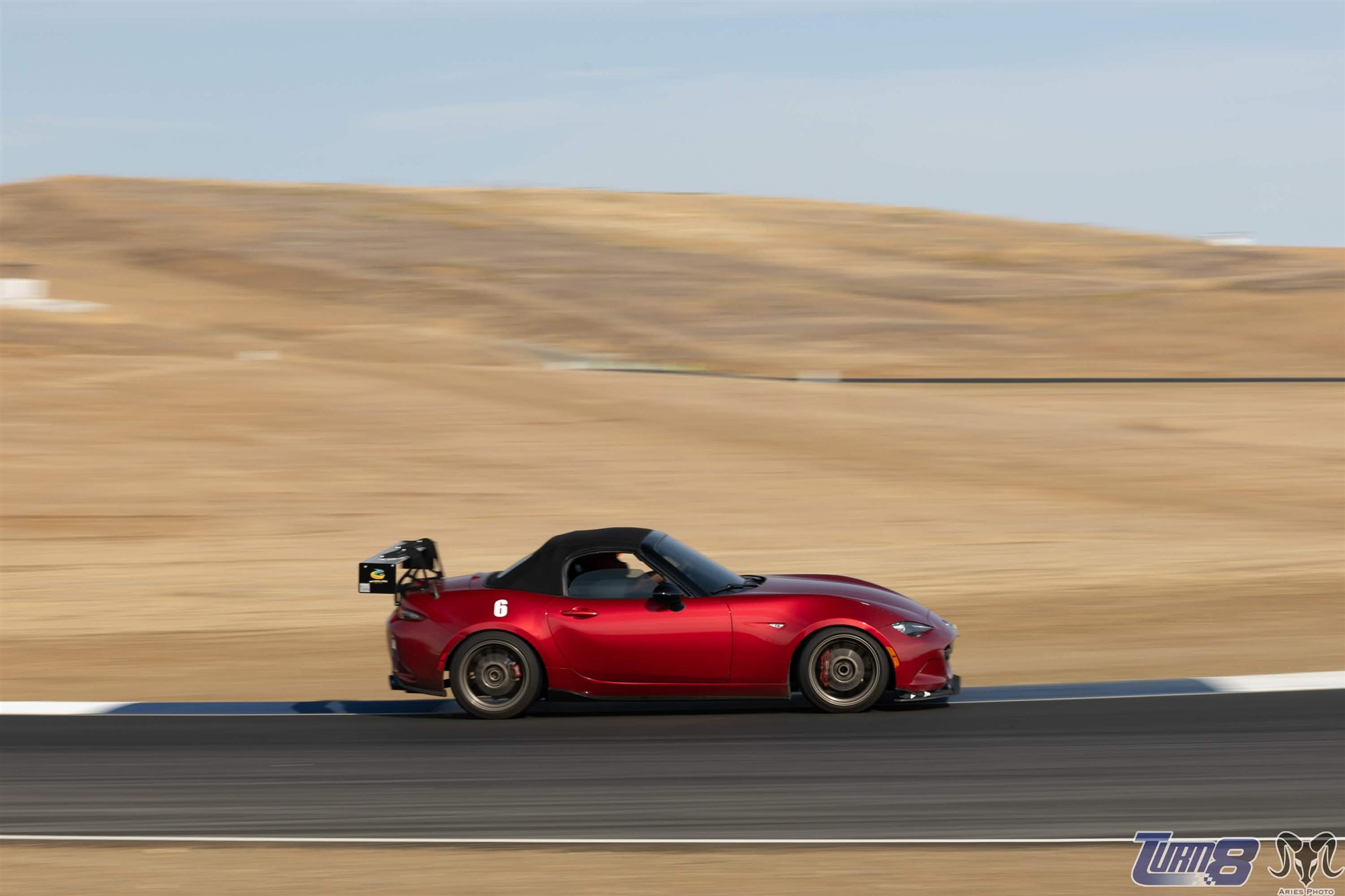
Photo: Aries Photo for Turn8
- Car
- 2016 MX-5, ND1
- Tracks
- Thunderhill West & East, Sonoma, Streets of Willow, Buttonwillow 13CW
- Best lap, Thunderhill West
- 1:27.93
- Weight removed
- About 100 lb
- Focus
- Getting faster as a driver
The idea
I'm not really trying to add power. The car makes close to what it made from the factory, so if I want to go faster, it has to come from me: braking better, carrying more speed through corners, cleaner lines. Anything I change on the car is there to give me more grip, keep it alive for a full session or teach me something.
From the car
Thunderhill East on the new repave, Sep 20, 2026. Best lap 2:05.76. More sessions on YouTube ›
Lap times
I time every session with a RaceBox. These are my best laps from each session, in order, with the best of the day highlighted. Anything with a ▶ has in-car video. I've also run Buttonwillow 13CW, but that was before I had the RaceBox, so I don't have times from it.
Streets of Willow Springs
Apr 25, 2026
| Session | Laps | Best lap |
|---|---|---|
| 3 | 3 | 1:32.06 |
| 4 | 1 | 1:49.28 |
| 5 | 1 | 1:35.42 |
| 8 | 5 | 1:32.22 |
First track day in this car
Thunderhill West
Sep 4, 2026
| Session | Laps | Best lap |
|---|---|---|
| 1 | 8 | 1:31.13 |
| 2 ▶ | 10 | 1:30.08 |
| 3 | 9 | 1:29.23 |
| 4 ▶ | 6 | 1:28.40 |
| 5 ▶ | 5 | 1:27.93 |
| 6 | 2 | 1:38.59 |
3.20 s faster than my first session
Learning the alignment
When I started, the car understeered. The front would wash out mid-corner and I'd have to wait for it. So I started learning what the alignment actually does and messing with it myself until the car turned the way I wanted. This is where I've ended up for now.
- Camber: −3.5°How much the top of the tire leans in. More of it keeps the tread flat on the ground when the car rolls in a corner.
- Caster: 5°How far back the steering axis is tilted. It adds camber as you turn the wheel and gives the steering more weight and feel.
- Toe: 0 front, slight toe-in rearWhether the tires point in or out a little. Zero up front keeps turn-in clean, and a bit of toe-in at the back keeps the rear calm on straights and under braking.
Parts I designed
Some of what's on the car I designed or made myself.
- BrakesCalipers I worked on with Darkworks. It's run by a close friend, the person who got me into racing in the first place. The calipers have no seals, so they take more heat, and the pads and rotors are bigger so I'm not replacing them as often.
- WheelsCustom wheels. I used FEA to find where the stress was low and took material out there to get the weight down. Less weight at the wheel means less unsprung mass for the suspension to deal with.
- FendersFiberglass front fenders I made, with a big vent behind each wheel and mesh across it. It gives the air in the wheel well somewhere to go.
- Headlight add-on In progressGoes over the headlight to keep debris off it and smooth out the air over the front corner. Version 1 is on the car now.
- Aero mirrors In progressMirrors shaped to cut drag. We scanned the factory ones so the new ones bolt right onto the stock mounts.
Scanning the car
For the mirrors, we pulled the factory ones off and 3D scanned them so the new design could use the stock mounting. Since the car was already apart, we scanned the whole thing too, so I have it for whatever I design next. The scanning was done with Epsilon Aero and Bomex.
What's on the car
- Aero9 Lives Racing splitter and rear wing, plus underbody panels. Downforce at both ends keeps the balance from shifting at speed, and the panels clean up the air under the car.
- SuspensionShaftworks coilovers and spherical bearings everywhere. The bearings replace the rubber bushings, so there's no slop and I can feel a lot more of what the car is doing.
- BrakesThe Darkworks calipers, with bigger pads and rotors.
- Engine & coolingOil cooler, headers and an Invidia N1 exhaust. The cooler keeps oil temps down over a whole session. Power stays close to stock on purpose.
- WeightAbout 100 lb out so far. Most of that is the stock seats, which I swapped for carbon Tillett B10s. The lighter wheels help too.
What's next
- More aeroFinish the mirrors first, then start on the bumpers using the scan.
- More seat timeHonestly the biggest one. More laps is still the fastest way to get faster.
Reading the tires
Lap times tell me if something worked, not why. So I built TireNet, four thermal cameras that show live tire temps on a screen in the cockpit. The spread across the tread tells me if the alignment is actually using the whole tire.